If you’re a homeowner in Eastern Ontario, power outages are not a question of if. It’s a question of when.
Ice storms, high winds, and long rural distribution lines mean outages happen more often and last longer outside major cities.
A standby generator is one of the most effective ways to keep your home running when the grid goes down.
This guide compares natural gas vs propane generators for Eastern Ontario homeowners, using real installation experience rather than brand preference.
Both options work well. The right choice depends on fuel availability, outage duration, and what you want to power.

Quick Answer: Propane or Natural Gas?
Choose Natural Gas If:
- You have an existing natural gas line to your home
- You want “unlimited” runtime without worrying about fuel deliveries (as long as the gas supply remains available)
- You live in a small town or subdivision with gas service
- You’d rather not deal with tank refills or on-site fuel storage
Choose Propane If:
- You’re in a rural area and don’t have natural gas service
- You want on-site stored fuel that doesn’t rely on natural gas pipelines
Choose Either If:
- You’re installing a standby system and making decisions based on your power needs, expected runtime, and budget
This guidance applies specifically to Eastern Ontario, where outage frequency and fuel access vary significantly by location.
Propane vs. Natural Gas Generators: Side-by-Side Comparison
The table below compares natural gas vs propane generators across the factors that matter most for Eastern Ontario homes.
| Factor | Natural Gas Generators | Propane Generators |
| Fuel Availability | Pipeline connection required | On-site tank storage |
| Runtime During Multi-Day Outages | Continuous while supply remains | Limited by tank size |
| Storage Requirements | None | Tank required (250 to 500+ gallons) |
| Upfront Install Complexity | Gas line sizing and tie-in | Tank placement, regulator, gas line |
| Ongoing Costs | Monthly utility billing | Fuel delivery; seasonal price changes |
| Cold-Weather Considerations | Consistent pressure | Tank pressure can drop in extreme cold |
| Safety Considerations | Ventilation and leak prevention | Ventilation, setbacks, tank siting |
| Maintenance | Similar for both fuels | Similar for both fuels |
| Noise | Model-dependent | Model-dependent |
| Best Fit for Eastern Ontario | Small towns with gas service | Rural properties without gas access |
Fuel Availability in Eastern Ontario
Do You Even Have Natural Gas Where You Live?
Fuel availability is the starting point in any propane vs natural gas generator decision.
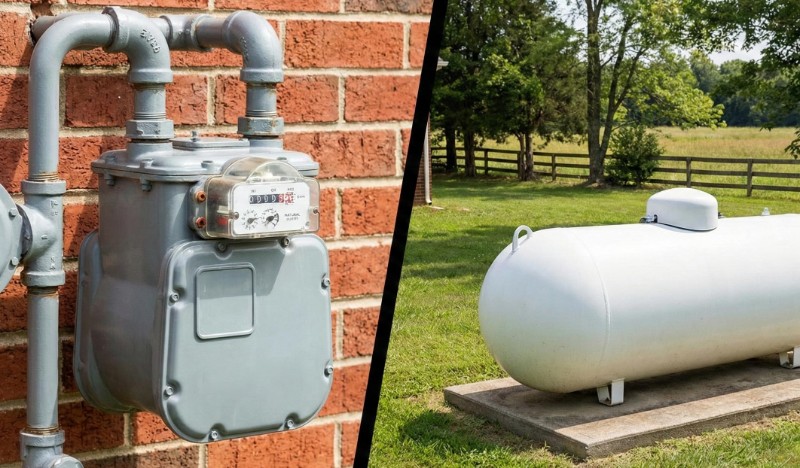
Many rural Eastern Ontario properties simply do not have access to natural gas. While most small towns are serviced, natural gas infrastructure drops off quickly outside town limits.
A simple check helps clarify your situation. If you have a gas meter on your home or see natural gas on your utility bill, you likely have access.
If not, propane is usually the practical option.
Propane Logistics (What Homeowners Should Know)
Residential standby generators typically use propane tanks ranging from 250-gallon up to 1,000-gallon tanks for optimum winter flow rates on high BTU demands.
A 250-gallon tank can power a mid-sized generator for several days at a moderate load. A 500-gallon tank can extend runtime further, depending on what you choose to power.
Tank placement must follow setback rules related to buildings, property lines, and ignition sources.
Delivery access also matters because during winter storms, propane trucks still need to reach your property. Also, keeping tanks topped up before storm season helps reduce risk.
Natural Gas Logistics (What Homeowners Should Know)
Homes with natural gas service can connect a generator directly to the existing line.
Proper line sizing and pressure are critical. Undersized gas lines can reduce generator power output or cause shutdowns. These checks are handled during a professional site visit.
As the homeowner, you don’t need to calculate this yourself, but it’s an important part of a safe and reliable installation.
Output, Efficiency, and Why Ratings Can Look Different
Many of the best generator manufacturers rate power output using propane rather than natural gas. This often leads to confusion during comparison.
Propane contains more energy per unit volume than natural gas. As a result, a generator may produce slightly less power when running on natural gas than on propane.
For example, a unit rated at 20 kW (kilowatts) on propane might deliver closer to 18 kW on natural gas.
This does not mean natural gas is inferior. Proper sizing accounts for these differences, so homeowners are not underpowered.
Some modern generators are designed to minimize output differences across fuels, and this is reviewed during equipment selection.
Propane vs. Natural Gas: Cost Discussion
What Actually Drives Total Cost?
The generator itself is only part of the equation.
Your total installed cost depends on several factors:
- Generator size (the kW power output)
- Electrical work and transfer switch installation
- Gas work (natural gas tie-in or propane tank and regulator)
- Permits and inspections
- Site preparation (concrete pad, setbacks, trenching)
Propane installations often have higher upfront costs due to tank requirements. Natural gas installations may require upgrades to existing gas lines, depending on capacity.
During an on-site assessment, we evaluate fuel access, gas capacity, and realistic outage scenarios to ensure the system is sized correctly rather than oversized or underpowered.
Operating Costs
The cost per hour of a generator depends on three things: load, fuel price, and runtime.
Here’s a rough rule of thumb you can use:
A 20 kW generator running at moderate load will use approximately two to three gallons of propane per hour or the equivalent in natural gas.
Multiply that by your expected runtime, and you can estimate your fuel costs. Propane prices fluctuate seasonally (typically higher in winter), while natural gas rates tend to be more stable since they’re regulated.
When comparing options, make sure you’re using consistent assumptions (same load percentage, same hours per day), so you’re comparing apples to apples.
Conversion/Dual-Fuel Considerations
Some generators come ready to run on either propane or natural gas, and conversion kits exist for many models. Whether this makes sense depends on your situation.
Dual-fuel flexibility can be appealing if you think your fuel availability might change in the future. Any conversion work should be done professionally and to code.
Reliability During Extended Outages
What Happens During a 1-Day vs 3-Day vs 7-Day Outage?
Outage planning is often overlooked, yet outage length has a major impact on fuel use and generator sizing.
1-Day Outage
For a short outage, both essentials-only and whole-home loads are manageable.
Essentials-only loads typically use a modest amount of fuel and place minimal strain on the system. Whole-home loads increase consumption, but fuel availability is rarely a limiting factor over a single day.
3-Day Outage
Fuel planning becomes more important for a 3-day outage.
Essentials-only loads allow fuel supplies to stretch comfortably across multiple days. Whole-home loads significantly increase consumption and may require larger propane tanks or confidence in an uninterrupted natural gas supply.
7-Day Outage
Extended outages, such as a week-long power disruption, demand careful planning.
Essentials-only operation prioritizes heat, refrigeration, water systems, and lighting while preserving fuel.
Whole-home loads consume fuel rapidly and often require larger generators, increased storage, or acceptance of higher operating costs.
Fuel Planning Checklist:
- Know your generator’s consumption rate at half load and full load
- Calculate how many days your storage tank will last under realistic conditions
- Keep your propane tank above 30% during storm season
- Have your propane supplier’s contact info handy (and know their emergency delivery policy)
The Eastern Ontario Reality
Hydro One serves most rural and small-town communities in Eastern Ontario, and its 2023 scorecard tells a clear story:
- Homeowners average nearly three power outages per year
- The average power outage lasts over seven hours
That’s roughly 21 hours without power annually, assuming nothing unusual happens.
Tree contacts and equipment failures are the leading causes, and during major storm events, it’s not unusual for crews to need several days to restore service to more remote properties.
For homeowners outside dense town centres, planning for extended outages is practical rather than pessimistic. Here’s why a standby generator is essential during a power outage.
Generator Safety, Code & Compatibility
Standby generators are not DIY projects. Beyond the technical complexity, there are real safety, code, and compatibility requirements that matter.
Placement & Ventilation
Generators must be positioned with proper clearances from windows, doors, and fresh air intakes. Exhaust contains carbon monoxide, and improper placement can be deadly.
Carbon Monoxide Prevention
CO poisoning is the leading cause of generator-related deaths. Proper installation, adequate clearances, and never running a portable generator indoors are non-negotiable.
Electrical Connections
The transfer switch isolates your home from the grid when the generator is running. This protects utility workers and prevents backfeeding. This work must be done by a licensed electrician and inspected.
At Atel Electric, we’re registered with the Electrical Safety Authority (ESA) and are focused on residential installations done right.
We handle all the permits, inspections, and the finer details, so you don’t have to guess whether the job was done to code.
Compatibility With Modern Heat Pumps
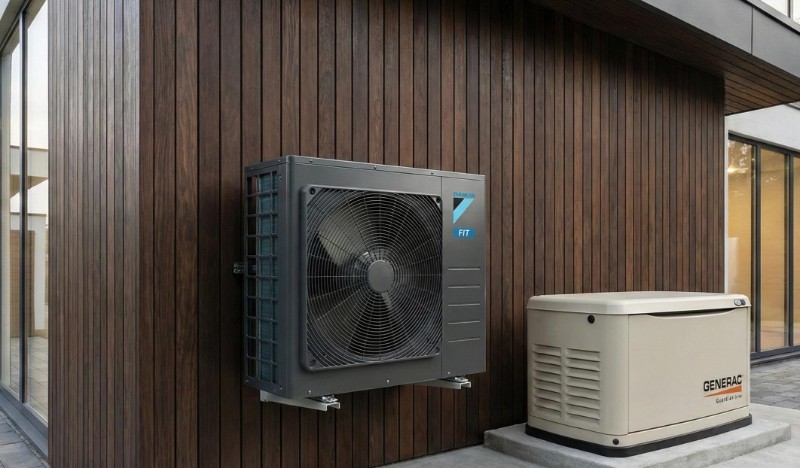
Not all heating systems are suitable for generator operation, even when the generator is properly sized.
Some modern heat pumps with variable-speed or inverter-driven compressors are not recommended by manufacturers to run on generators. This includes systems such as the Mitsubishi Zuba and WaterFurnace 7 Series geothermal.
In real-world installations, we have seen equipment component failures linked to generator power quality, including voltage irregularities that can occur during generator operation.
If your home relies on a variable-speed heat pump, generator planning should include a review of manufacturer guidance, warranty implications, and backup heat options to avoid costly damage.
Conclusion
The best fuel choice for your standby generator comes down to three things: fuel availability, expected outage duration, and what you want to power.
If you have natural gas service, it’s often the most convenient option with no tanks to monitor and no deliveries to schedule.
If you’re rural and gas isn’t available, propane is best because it gives you independence and on-site control of your fuel supply.
Still not sure where to start? Our Home Generators Buyer’s Guide can help.
Ready for a Clear, No-Pressure Recommendation?
Request a quote for generator installation or give us a call at 613-535-9909
We serve Kemptville, Brockville, Metcalfe, Embrun, and surrounding rural communities throughout Eastern Ontario.